
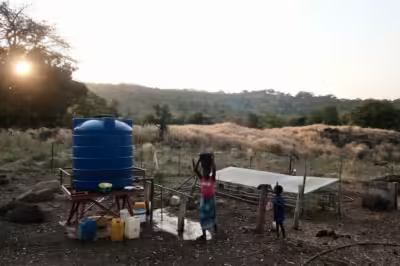
A woman carries a bucket of water in front of a large set of solar panels that provides power for a water pump in Iwol village in the remote Kedougou region of Senegal on November 14, 2023. Solar panels in various shapes and sizes offer cheap, consistent electricity to many communities with little or no access to mains power where the sun shines most… days of the year. (Photo by Guy PETERSON / AFP)
Singapore-based entrepreneurs have developed long-lasting battery storage technology that could offer reliable support for solar and wind power in remote locations.
Avishek Kumar, chief executive of VflowTech, will show the technology at Cop28 and tell delegates how its vanadium flow batteries store energy from the Sun and wind during the day to power industries and homes by night.
The company’s PowerCube technology, he says, comes with an assurance that performance will not drop and that the batteries will last for more than 20 years, helping people to stop using polluting diesel generators.
It has the capacity to supply a 50 kilowatt-hour (kWh) load for 24 hours per unit – more than double the needs of the average family.
The company will create a virtual model at Cop28 so audiences can see how the battery technology has worked for more a decade to help keep the lights running on an island off Singapore where residents had previously used diesel generators.
“They were burning litres of diesel. Instead, we have put in a battery, connected it with renewables and it’s now powering the whole island with a net zero, fully renewable solution 24/7,” Mr Kumar told The National.
“The primary objective is to showcase how our technology is available for mass deployment.”
He plans to build factories to manufacture vanadium flow batteries in India and later in the UAE.
Why massive battery storage is key
Alternative forms of battery storage, including vanadium, a metal found in the Earth’s crust, are attracting attention with the build-up of interest in renewable energy.
Access to clean energy is one of the United Nation’s key sustainable development goals with close to two billion people still relying on polluting fuels.
Solar and wind can generate cheap electricity but supply can be erratic. For entire grids to run purely on renewable energy, an enormous amount of storage is required to prevent blackouts.
Industries and major infrastructure projects must be assured of consistent supply without any fluctuations in power to make the switch to clean energy.
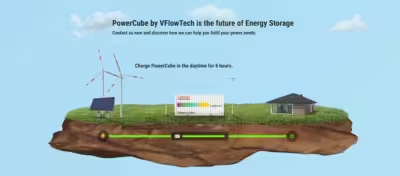
A PowerCube, or vanadium flow battery unit, stores solar and wind energy during the day to keep the lights on in homes and businesses at night. Photo: VflowTech
“Most leaders have committed to go net zero by 2050,” he said. “One simple way is to power ourselves with renewables 24/7, but that cannot be done without energy storage.
“So when there is no sun or wind, how will you power yourself? In this context energy storage is an important enabler.”
Currently, lithium ion and lead acid batteries are the main types used for energy storage. But these batteries need to be replaced every few years and their efficiency degrades with time.
“The problem with contemporary lithium ion technology is that it’s OK for use for a short time but, for instance, if you talk on your phone for longer than an hour or two, it heats up,” said Mr Kumar, who is also VFlowTech’s co-founder.
“Performance degrades and you have to replace these batteries more frequently.”
Engineers around the world have been working on alternative storage devices and one option is vanadium redox flow technology.
China, Russia and Australia have the world’s largest vanadium deposits.
China is among the countries taking a giant leap in the vanadium flow battery system with a facility opened last year in north-east Dalian city that meets the electricity demand of 200,000 residents.
What is vanadium technology?
VFlowTech was incubated in Singapore’s Nanyang Technological University with researchers working for more than 10 years to fine tune the vanadium battery system.
“The advantage of the vanadium flow battery technology is that it has a lifetime of 25 to 30 years and the performance does not degrade, which makes it an ideal solution for the long run,” Mr Kumar said.
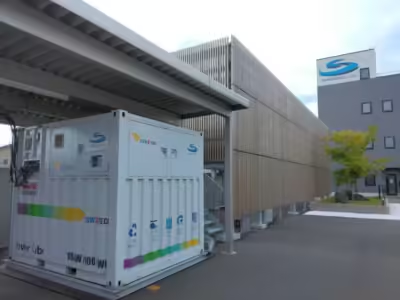
A building powered up in Japan. Industry and infrastructure projects require a consistent supply to make the switch to clean energy. Photo: VflowTech
“There is also zero performance degradation, so if the performance is 100 per cent today, after 25 years you will also get 100 per cent of the energy. This makes it highly sustainable; vanadium is also highly recyclable.”
VflowTech’s battery storage units – called PowerCubes – range in size from a double-door fridge to a huge container.
The technology powers electric vehicles in Australia, supplies electricity to office buildings in Japan and to more than 30 homes and businesses in Pulau Ubin island off Singapore’s north-east coast.